
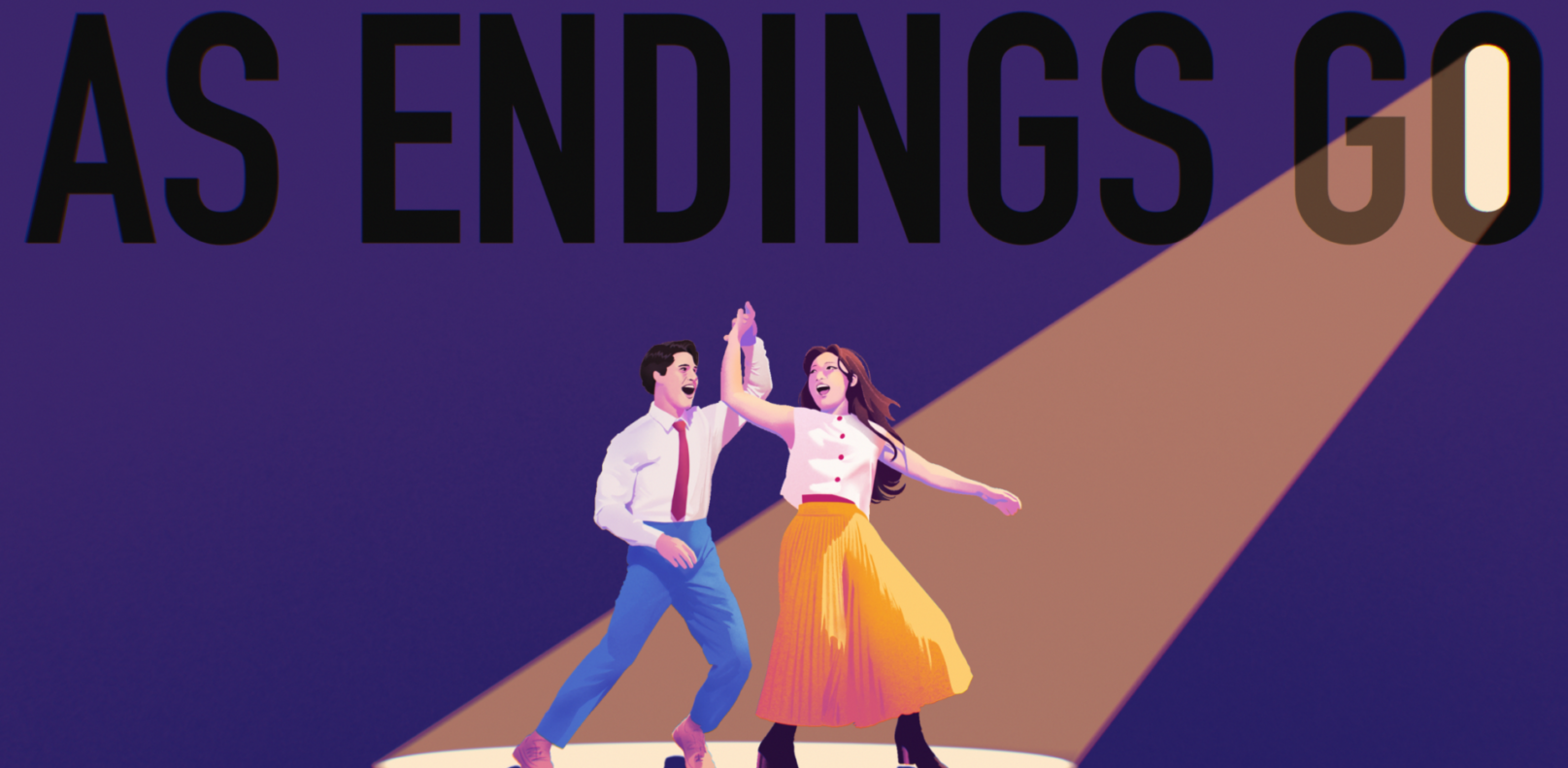
As I sat down in the Belasco Theatre, I began to prepare myself for what I knew was going to be a riveting performance. The theatre felt lit with a special kind of magic that night: children scurrying along to find their seats to the right of me, a couple obviously on their first date grabbing a drink to the left, all of us anxiously awaiting the curtain call. Before the show even began, we were immediately immersed in the bubbly hyper-internet world with one of the characters, who I came to know as James, sitting at the foot of the curtain reading his paper. I knew from that moment on, I was going to enjoy the show. However, I was not prepared for just how awestruck it left me.
“Maybe Happy Ending,” a new Broadway musical, tells the story of two Helperbots (house robots designed to assist their owners with their every need) named Claire (Helper-bot 5), and Oliver (Helper-bot 3). Both living in Seoul, South Korea, both slowly dying out, and both abandoned by their owners. As Claire and Oliver develop a friendship, they go on an adventure to try and find Oliver’s owner James, so they may be reunited. Although the plans alter based on unfortunate events, the two found meaning in the trip after all: each other. As they fall more in love, we find that Claire’s model is obsolete; no longer receiving new parts … meaning she only has a few years left to live. With this devastating news, the two decide, in a very “Eternal Sunshine of the Spotless Mind” way, to erase the memories they have of one another. In the climax of the musical once they go their respective ways, they each take different routes on what looks like “moving on.”
This show builds a little world that intrinsically sucks you in from the first scene. Each moment felt captivating and awe-striking. Its two and a half hour long run with no intermission makes use of all the choices made and doesn’t waste any of its time. Both the writing and music have bold value, and the characters are so well-written that you find yourself easily finding bits and pieces of yourself in them. I found myself falling in love with the characters as they began to fall in love with one another. It’s a show that feels incredibly conversational and humanistic (even though it’s centered around two Helperbots). The lyricism in this musical score, as well as Oliver and Claire’s shifts in dialogue really captured the feeling of falling in love, and the series of events that can follow thereafter.
The show used particular and intentional language that pierced the story into the hearts of the audience. There were many subtle moments where we saw shifts in the language the two of them cultivated together, showing us the progression of them falling in love. While the two are on their journey to find James, they realize it may be much easier to create a false narrative that the two of them are married. They create an elaborate story of how they met on a rainy day in Paris and fell in love, each of them providing their own fantasies of what that day encapsulated. As they cultivated this phony relationship, I couldn’t help but draw parallels to how the beginning of relationships feel. We create this mirage, ideas of the person and what we expect or think the relationship will play out to be. This is the stage where, because so much is a mystery, the imagination has the ability to run rampant. We fill our minds with aspirations of what may come with this new person. The phase where everything feels romantic, even small flaws you see in them. However it’s those flaws ,once the rose-tinted glasses come off over time, that help you see them for who they really are. As Claire and Oliver journeyed along in their phony relationship, a lot of their dialogue began to shift from fantasy to reality.
Oliver’s constant “you’re welcome” motif was such a funny and charming running joke that transformed throughout the show. This particular cadence draws to Oliver’s categorical and absolute personality. Originally, Claire finds this amusing and annoying, and uses it to tease Oliver’s Helperbot model. We gradually see a shift when Claire says “you’re welcome” for the first time after Oliver thanks her. The delivery of this line creates a subtle shift; the language feels sincere and kind. We see the true moment where Claire goes from joking with Oliver, to falling for him. As she jokes about his constant programming of “you’re welcome” after being thanked, this switch of language creates an opening for the audience to experience Claire’s growing care for him. This ignites more conversation of what it’s like to slowly fall for someone. It created such a radiant feeling in the audience, as people laughed at the endless teasing of Oliver’s “you’re welcome” in the beginning, to then hearing sweet sighs and “awws” from people when Claire responded endearingly to his speech. For it’s sometimes in those small, kind gestures and lingering glances that help change the way you feel for someone. Those are the raw moments where you expand, inch-by-inch, room in your heart for them.
As their journey is complete and they go back to their respective rooms, Oliver and Claire begin to question their feelings for one another. During this contemplative state, the song “A Sentimental Person” begins to play, sung by Gil Brently. Gil exists as a third person omniscient pov of Oliver’s mind. His frequent jazz scores throughout the show offer the audience a play-by-play of how Oliver processes his budding relationship with Claire, as well as the world around them. In the beginning of this song he states, “I’m not a sentimental person, it’s not what I’m designed for, can’t say I’ve ever pined for someone to break my heart.” This lyric completely encapsulates the fear of falling in love with someone. Once we realize attraction is there, it becomes part of human nature for us to run from it out of anxiety for what could possibly go wrong. We convince ourselves that we aren’t made for a relationship and predestine it to end in heartbreak. Falling in love is a special but awfully terrifying thing. Allowing yourself to open up and have someone see all your flaws and the many facets of who you are is daunting. It becomes easier to pretend as though love isn’t there.
Though Gil offers these sentiments at the beginning of the ballad, he follows it by saying, “ … so why does the moon seem brighter, and my feet much lighter?” He then changes his speech from, “I’m not a sentimental person” to “If I’m a sentimental person …” For as much as we can try and convince ourselves we don’t feel something, when it’s meant to be, our bodies and emotions have a way of bringing the truth to light. We can try to outrun our feelings all we want, but oftentimes, the very thing we run from we can end up chasing.
The music subtly changes as Oliver and Claire begin to admit their feelings for one another as the pair decide to cultivate a relationship. In the song, “When You’re in Love,” the two talk about the sometimes lonely feelings that come with being in love. They sing about how when in love, “you’re only half, when one is what you were.” This feeling is evoked when you begin to build a comfortable life with someone else. You create space in your room, mind, and heart for them. In this song, we begin to see more of Claire’s items in Oliver’s room — and vice versa. This mimics the idea of how much space we create for those that we fall in love with. As you build a relationship with someone, you integrate them into your everyday routine. Sending morning texts becomes instinctual, weekly dates feel natural, and by spending so much time together, sometimes not having them around can feel out of place. When in love you always want to maintain a sense of self, but as you captivate yourself with someone else, part of your being begins to live in each other. Oliver and Claire, while maintaining their own sense of self, grow to understand that falling in love is allowing yourself to be forever changed for the good by the one you love.
As a drastic shift in Claire’s life causes her to reevaluate their relationship, they decide it would be better to rid themselves of the memories that they shared together. At this point in the musical, the song, “Then I Can Let You Go” plays. Throughout the song, the two of them find all the ways in the world to avoid breaking up by listing all the things they should do together before they call it quits. Providing one of the final stages of a relationship — when you know it’s no longer feeling right, but you can’t bear to let go of the person. This stage feels like a callback to the beginning where you go back to pretending, posing as though things are okay because internally you still really want to be with that person. Your brain floods with ideas of all the things you haven’t done together and you allow those things to keep you tied together… even when it isn’t right. But again, we can’t outrun what our instincts tell us. As they do all of these silly activities with each other, we see the real pull they feel of having to let one another go. But in the same breath, we forget that losing that person doesn’t mean that they’re actually gone. Even when things are over, there are parts of them that will forever live in us.
In our society, we harbour break ups as terrible unravelings. Having to end anything always carries such a bad connotation. This show offers a different light on what we view to be a tragic thing. In the title track of the show during one of its last songs, Oliver sings, “But maybe letting go and moving on before we make a mess, is that a happy ending? More or less …” This line shows us that sometimes when we allow ourselves to end things before they get to a place of no return, doing so allows us to keep that thing beautiful. Holding onto the beauty of what was really can be a happy ending. What a gift it is in all the upheaval of our human nature to be able to fall in love — to have the ability to build something so lasting that it completely changes us. And in that way, does it ever truly end? As bits and pieces of those that we’ve loved live on in us, does that not keep them alive? Those memories and experiences still live on just somewhere in the past. All that we have felt before still currently lives inside of us, and with that knowledge, maybe endings don’t have to be so sad after all. Whether it’s a relationship with a person or a relationship with something (a passion project, hobby, or even a specific space you feel tied to), this show provides us the opportunity to appreciate every stage of love, even its “ending.”
But oftentimes, endings have a way of allowing for new beginnings. In the show’s final scene, we see Claire (who has chosen to erase all of her memories of their relationship) ask to, once again, borrow Oliver’s (who didn’t erase his memories) charger. This was the very first interaction the two of them shared at the beginning of the musical. This call to the beginning gives the viewers a chance to contemplate whether we believe they sparked their romance again. The things that are meant for us, have a way of returning back to us in their appropriate time. The ambiguity of what Claire and Oliver’s relationship came to be after this scene created a near perfect ending to a near perfect musical. Maybe happy endings can open the door for beautiful beginnings.
The endless tears streaming down my face created wave puddles in the notes I found myself trying to write throughout the show’s duration. Watching this show felt like both a gift and love letter in itself. As I stood to applaud this incredible performance, tissues full of my snot and tears flew from my lap onto the floor. I picked up my tissues along with pieces of my heart, and looked along the ground to find the culmination of tissues along almost every row. The magic that I felt that night I got to share with others in the audience, which in a small way connected us all. Each of us came in with our own emotional baggage, in all different stages of life and love. This show opened up something in everyone that night. Maybe happy endings do exist, for there is so much goodness that can be found in an ending that leads to possible new beginnings.
Run, don’t walk to see this phenomenal performance — seriously. Although the performance I went to was the last official night that Helen J. Shen, the original Claire, performed (this making it feel even more special) most of the cast is still currently in their roles. Claire Kwon is currently playing the role of Claire and Darren Criss is still in his role as Oliver. He is set to leave the show on May 17, 2026, and the show itself doesn’t currently have a set closing date! Become a part of the firefly family and leap to go see this magnificent show. Hwaboon, Oliver’s plant and arguably other love of his life, will welcome you with open arms!
Graphics: Maddie Bui